
Soap calculator,
right to the gram
Lye or potash, water, superfat, glycerine, TFM and the properties of your soap: build your recipe and watch it calculate live. Aleppo soap recipes included, from the home of Aleppo soap.
Build your soap
Pick a recipe or start from scratch. Everything recalculates as you type, and your recipe can be shared with a simple link.
Type of soap
A recipe to get started
Your oils
| Oil | Share | Weight | Remove |
|---|
Settings
Your soap’s profile
Green band = the usual range for a “modern” bath soap. Falling outside it is not a flaw: an Aleppo soap, very rich in olive oil, lathers gently and is exceptionally mild. That is its signature.
Fatty acids
Average breakdown, weighted by the weight of each oil (reference data; an oil varies with its origin and harvest).
The step-by-step recipe
From weighing to finished soap, with the quantities calculated above for your recipe. Allow about an hour of work, then the cure. Change the recipe or the oils: the quantities follow.
What you’ll need
Ingredients
Equipment
- Scales accurate to the gram, ideally to a tenth of a gram for the lye
- Safety goggles, gloves, long sleeves
- A stainless steel or thick plastic (polypropylene) container for the lye
- A stainless steel pan for the oils
- A stick blender and a silicone spatula
- A kitchen thermometer
- A silicone mould, or a cardboard or wooden box lined with baking paper
Never use aluminium: lye attacks it. Keep these utensils for soapmaking only.
- 1
Get everything ready
Goggles, gloves, long sleeves. A well-ventilated room, children and pets kept away. Line the mould with baking paper (no need with a silicone mould). A splash? Rinse at once under running water for 15 minutes; if it gets in your eye, rinse, then see a doctor.
- 2
Weigh
Each ingredient in its own container, to the gram: — of oils, — of lye, — of cold distilled water.
- 3
Dissolve the lye
Pour the lye into the water, never the other way round, next to an open window and without breathing in the fumes. Stir until the solution is clear: it gets very hot and can exceed 80 °C. Let it cool to around 40 °C.
- 4
Warm the oils
Gently heat the oils to 35 to 45 °C. Butters and laurel berry oil, which set when cool, must be fully melted. Oils and lye solution at roughly the same temperature.
- 5
Blend to trace
Pour the solution into the oils in a thin stream. Blend in short bursts, stirring with the spatula in between. Stop at “trace”: the mixture has the consistency of custard and a drizzle on the surface leaves a mark. Rich in olive oil, it often takes 5 to 15 minutes.
- 6
Add a scent, if you like
At trace, add your essential oils, 3% of the oils at most, and stir in with the spatula. In an Aleppo soap, the laurel oil is fragrance enough.
- 7
Pour into the mould
Pour the soap into the mould and tap it to release air bubbles. Cover with cardboard, then a towel; leave to rest for 24 to 48 hours. Wash your utensils with your gloves on: fresh soap is still caustic.
- 8
Unmould and cut
Unmould when the soap feels firm, wearing gloves: 1 to 3 days, longer for an all-olive soap. Cut the bars with a knife, still wearing gloves.
- 9
Leave to cure
On a rack, in a dry, airy room, out of the sun; turn the bars from time to time. Allow at least 4 to 6 weeks before use, for about — of soap. An Aleppo soap benefits from a much longer cure: Aleppo soap makers dry their bars for about nine months.
The ingredients for your recipe
The oils in your recipe available from Alepia, plus organic essential oils to scent it.
In your recipe
Essential oils, optional
30% off your first order with the code BIENVENUE30 until 31 Dec 2026

Six weeks for your soap, nine months for an Aleppo soap
The soap you make with this calculator cures for 4 to 6 weeks before use. Traditional Aleppo soap, on the other hand, dries for about nine months: two oils, olive and laurel, and a great deal of patience. Can’t wait? Ours have already done their drying.
- The oils are hot-processed for several days in huge cauldrons
- The soap is poured onto the floor, cut by hand and stamped
- The bars dry for about nine months, stacked in towers; the crust turns golden while the heart stays green
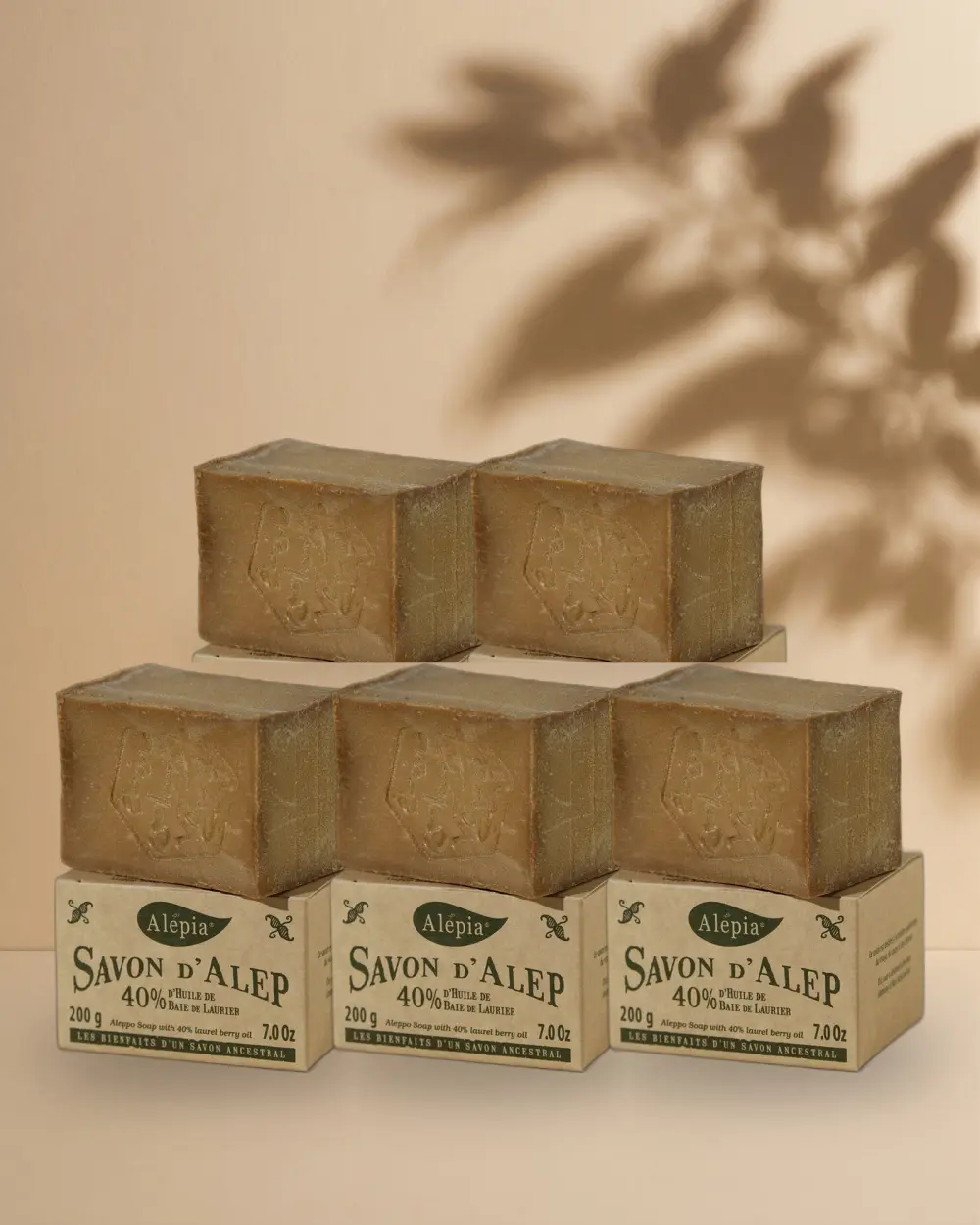
Fancy making it yourself? Our organic Aleppo oil already combines olive and 10% laurel: choose the “Aleppo oil soap” recipe, then follow the step-by-step recipe.
Soapmaking safely
Caustic soda and caustic potash are corrosive. Four rules, no exceptions.
Goggles, gloves, long sleeves
A splash of lye burns skin and eyes. Work in a ventilated room, with children and pets kept away.
Lye into water
Always pour the lye into cold water, never the other way round: the reaction gets very hot and gives off fumes.
Scales to the gram
Weigh everything; never measure by volume. Use stainless steel, thick glass or polypropylene; never aluminium.
4 to 6 weeks of curing
Let the soap dry in the open air before use, longer if it is rich in olive oil. A soap you sell or give away is a cosmetic product: EU Regulation (EC) No 1223/2009, or the UK Cosmetics Regulation.
Frequently asked questions
What is superfat in soap?
Superfat is the share of oil deliberately left unsaponified: you use a little less lye than it would take to turn all the oils into soap. 5 to 8% is the usual figure for a bath soap; it makes the bar gentler and ensures no free lye is left.
What is the difference between lye (NaOH) and potash (KOH)?
Caustic soda (sodium hydroxide, NaOH) makes a hard soap bar. Potash (potassium hydroxide, KOH) makes a soft or liquid soap, like black soap. Commercial potash is about 90% pure: the calculator takes this into account.
How is Aleppo soap made?
Traditional Aleppo soap combines olive oil and laurel berry oil, hot-processed in huge cauldrons. The soap is poured onto the floor, cut, stamped, then left to dry for about nine months. The percentage shown (5%, 25%, 40%) is the share of laurel oil.
Can you make Aleppo soap with Aleppo oil?
Yes: Alepia Aleppo oil comes ready-blended (90% olive oil, 10% laurel berry oil, organic). A single oil to weigh gives you an Aleppo soap with 10% laurel and a laurel scent. For 270 g of oil (3 bottles of 100 ml), allow 34.8 g of lye and 70.6 g of water at 5% superfat: choose the “Aleppo oil soap” recipe to adjust the quantities.
How do you make Aleppo soap at home?
Pick an Aleppo soap recipe in the calculator, then follow the step-by-step method: weigh the oils, lye and water, dissolve the lye in the water, warm the oils to around 40 °C, blend with a stick blender until trace, pour into the mould, then unmould and cut after 1 to 3 days. Leave to cure for at least 4 to 6 weeks; Aleppo soap makers dry their bars for about nine months.
How long should cold process soap cure?
Allow 4 to 6 weeks of curing in a dry, airy place. Saponification is almost complete within 48 hours, but the water still has to evaporate: the soap becomes harder, milder and longer-lasting. A soap rich in olive oil benefits from an even longer cure.
What is a saponification value?
It is the amount of alkali needed to saponify 1 gram of an oil, expressed in mg of potash (KOH). Every oil has its own: coconut oil needs a lot, jojoba oil (a wax) very little. The calculator uses these values for each oil.
What is the TFM of a soap?
TFM (Total Fatty Matter) is the share of fatty acids in the finished soap. The higher it is, the more concentrated the soap is in cleansing matter and the less water it contains. A traditional Marseille soap shows 72% fatty acids.
Results are given as a guide, based on average saponification values. Check your recipe before making it; Alepia cannot be held responsible for how it is carried out.