


- -30%
How to Choose Aleppo Soap: The Complete Guide
- Dr Constantini
- 197 likes
- 0 comments

Aleppo soap is much more than a bar of soap: it is an ancestral, gentle and natural soap the whole family can share. But how do you choose the best Aleppo soap among so many offers? In this guide we cover its ingredients, the quality criteria, the laurel oil percentage question and how to spot an authentic bar.
In a hurry? Take our "Which soap for my skin?" quiz: seven questions, one minute, and a soap suggestion that fits your habits.
Aleppo soap benefits: why so many people love it
Aleppo soap is loved for its mildness and its short ingredient list: olive oil, laurel berry oil, lye (which disappears during saponification) and water. It works for everyday use:
- Body: it cleanses gently and leaves skin feeling soft.
- Face: its creamy lather suits a gentle cleanse, morning and evening.
- Hair: many people also use it as a natural shampoo bar.
- Shaving: its fine lather is easy to work up with a brush.
Like any true soap, it is slightly alkaline. After rinsing, skin naturally returns to its usual balance within a few hours.
What is Aleppo soap made of?
Authentic Aleppo soap is 100% plant-based, with no additives. What sets it apart from other soaps?
An ancestral and ethical recipe
Many commercial soaps are made from animal fats ("sodium tallowate" from beef tallow, "sodium lardate" from lard) or from palm oil, whose intensive farming contributes to deforestation in Indonesia and Malaysia, home of the orangutans. Saying no to palm oil is an ethical choice.
"Soap-free bars" (syndets) rely on synthetic surfactants and often contain preservatives and fragrance. Aleppo soap takes the opposite approach: a very short ingredient list anyone can read. Learn more: why read the INCI list.
Aleppo soap is built on two noble oils:
- Olive oil: for its legendary mildness.
- Laurel berry oil: for its distinctive woody scent and richness.
No palm oil, no animal fat, no synthetic surfactant, no preservative, no colouring: it is one of the simplest soaps there is. At Alepia, our products follow an ethical charter, and our face soaps are certified organic.
Are all Aleppo soaps equal? The key quality criteria
All Aleppo soaps look alike, but they are not equal! Quality depends on several factors:
- Oil quality: choose first cold pressing or second hot pressing. Avoid fermented pomace oils (unpleasant smell) or oils extracted with petrochemical solvents (naphtha, hexane), a taboo subject in the industry.
- The master soap maker's expertise: a thousand-year-old craft passed down through generations, combining technique and tradition.
- The laurel berry oil percentage: the higher it is, the more precious (and expensive) the soap, but it is not the only criterion. A well-made 1% laurel soap beats a carelessly made 30% one.
At Alepia, our Aleppo soaps benefit from strict traceability and rigorous checks. We use virgin oils, with no petrochemical solvents, in line with our organic certifications. Our workshop received the Artisanal Excellence medal from the French Chamber of Trades, as well as its highest distinction: the title of Master Artisan Soap Maker.
An analogy: picture the same stuffed tomato in two restaurants. In one the chef excels; in the other the dish is bland despite the same recipe. Aleppo soap is no different: quality comes from the ingredients, the technique and the patience of curing.
How to choose Aleppo soap: tips to spot an authentic bar
To choose your Aleppo soap, look at it closely:
- Colour and scent: light beige to brown outside, beige to green inside. Bars made with virgin oil are lighter (beige to pale green), a sign of quality.
- Stamp: engraved on one side, with the master soap maker's Arabic characters.
- Floating: a well-cured bar (about 10 months) often floats, but this is not an absolute test. A bar that is too light is no guarantee of quality; in Aleppo it is even nicknamed "crazy soap".
The result: a mature, mild soap that is a pleasure to use.
Why choose Aleppo soap?
- A short ingredient list: two plant oils, no synthetic surfactant or preservative.
- One soap for everything: body, face, hair and shaving. Perfect for travel, as told in one bar in the pack.
- A responsible choice: no palm oil, and a bar that lasts a long time.
Aleppo soap vs Marseille soap vs black soap
To choose well, let's compare Aleppo soap with two other classics:
| Criterion | Aleppo soap | Marseille soap | Black soap |
|---|---|---|---|
| Main ingredients | Olive oil and laurel berry oil | Olive, coconut or palm oil depending on the maker | Olive oil, potash |
| Use on skin | Gentle cleansing of body, face and hair | All-purpose cleaner, often kept for laundry and the home | Scrub with a kessa glove (hammam ritual) |
| Format | Bar cured for several months | Cube or flakes | Paste |
| Palm oil | Never | Depends on the recipe | Depends on the recipe |
Aleppo soap is the mildest of the three for washing. Marseille soap is more of a household soap, and black soap is mainly used as a scrub: see our home hammam ritual.
The different Aleppo soaps: which laurel percentage?
Aleppo soap balances olive oil (mildness) and laurel berry oil (character and scent). Here are the main versions:
- 1% laurel (99% olive): the most affordable and the mildest, for the whole family. See the 1% Aleppo soap.
- 5% laurel: perfect for daily washing, including sensitive or dry skin. See the 5% Aleppo soap.
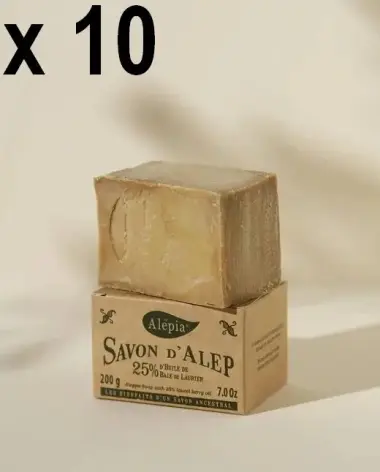
- 25% laurel: richer in laurel, popular for combination to oily skin and as a shampoo bar. See the 25% Aleppo soap.
- 40% laurel: intense scent, the richest of the range. See the 40% Aleppo soap.
Why not more (50, 70 or 100%)? We master the technique, but the high cost of laurel oil limits production. Ask us about limited editions! Each percentage is explained in our Aleppo soap laurel percentage guide.
Premium Aleppo soap: excellence for your daily wash
The pinnacle of Aleppo soap? Our Premium range, made with virgin oils and enriched with Dead Sea mud, clay, 7 oils or goat's milk. It is designed for washing the face and dry or delicate skin. Its price reflects the quality of its ingredients; during the promotions announced in our newsletter, it becomes affordable for everyone. Discover the Premium goat's milk soap.
How to store Aleppo soap
Keep it in a dry place, away from sunlight: it matures over time and becomes even milder. An old soap is a treasure! Before first use, rinse it under water to remove dust. Between uses, leave it on a draining soap dish.
A little story from Aleppo
Walking through the Great Souk of Aleppo with a master soap maker friend, we came across a stall full of dusty soaps. "Not abandoned," he told me, "these soaps are several years old and they are the mildest of all." At Alepia, try our Mathusalep, vintage 2011, a real treat. Discover Mathusalep.
FAQ: your questions about Aleppo soap
- Is Aleppo soap vegan? Yes, it is 100% plant-based, with no animal fat.
- Can I use it on my hair? Yes, many people use it as a shampoo bar. Lather between your hands, apply, then rinse well.
- What is the difference with Marseille soap? Aleppo soap contains laurel berry oil and is mainly meant for washing, while Marseille soap is more versatile, including for the home.
- Is it certified organic? At Alepia, our face soaps are, with an ethical commitment.
- Is it suitable for children? Yes, its mildness makes it a soap the whole family enjoys.
- Which laurel percentage should I choose? 1% or 5% for everyday family use, 25% or 40% if you like a soap richer in laurel. Our 1-minute quiz helps you decide.
Go further
- Which soap for my skin? The 1-minute quiz
- Aleppo soap: 5, 25 or 40% laurel, which one?
- All our Aleppo soaps
- Free soap calculator: want to make your own soap? Lye, water and superfat to the gram, Aleppo soap recipes included.
You now know everything you need to choose your Aleppo soap. Order yours on alepia.com and share this guide with your friends!
Dr CONSTANTINI
Medical Biologist
Founder of Alepia
Related products

- -20%
- Pack

comments (0)